
Shumee’s low wooden discs are the more manageable introduction for younger toddlers. Abley’s textured stones suit children aged three and above who benefit from strong tactile feedback, while Makarci Balance Stepping Stones offers deeper, stackable stones for varied open-ended play. Stapelstein and Gonge provide refined international benchmarks but currently involve substantially higher costs and uncertain Indian support.
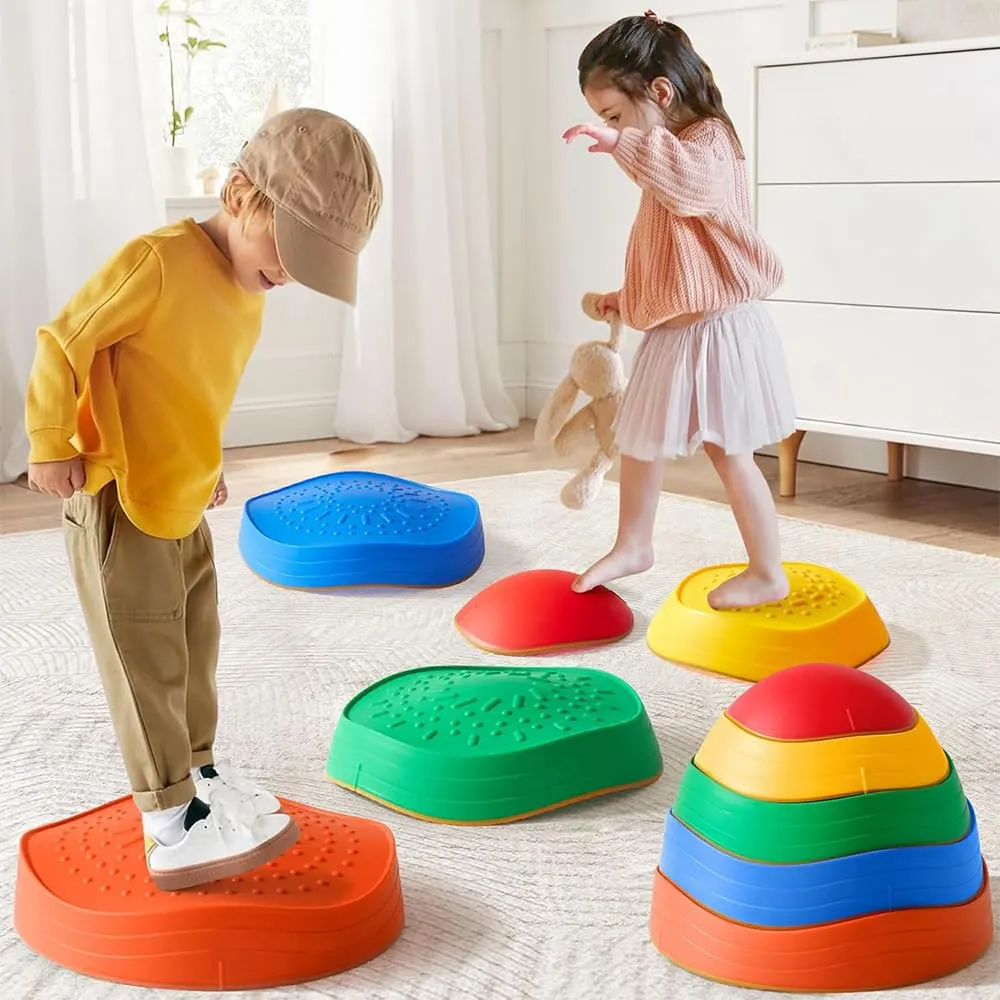
Balance stepping stones are movable platforms that children arrange into pathways and obstacle courses. A child can initially walk between closely placed low discs, then progress to wider gaps, curved routes or slightly varied heights.
Their appeal is simple: they turn a small area into an active-play space and stack away afterwards. That makes them relevant for apartments and periods when heat, rain or air quality limits outdoor activity.
The category is expanding internationally beyond conventional plastic “river stones.” Stapelstein offers lightweight foam elements that can be stacked, spun and combined with balance boards. B. toys has created compatible sensory stones and balance beams. Gonge offers River Stones, Hilltops and modular parkour elements. This product expansion is evidence of international category development; stronger Indian demand remains an informed projection rather than established mass adoption.
The World Health Organization recommends frequent physical activity and limited sedentary screen time for children under five. Stepping stones can contribute to active play, but they should complement outdoor running, climbing and free movement, not replace them.
Balance stepping stones are one of the best investments parents can make for their child's physical, cognitive, and social development. Unlike single-purpose toys that children quickly outgrow, these versatile stepping stones adapt to a child's growing abilities from toddlerhood through elementary school.
Prices and availability were checked on 3 September 2026 and can change.
Product | Stated age | Format | Indicative price/status |
|---|---|---|---|
Shumee Wooden Stepping Discs | 1+ | Six low wooden discs | ₹2,247 |
Abley’s Sensory Stepping Stones | 3+ | Five textured foam stones | ₹3,865 |
1+ | 5 stackable stones | ₹1,906 | |
National Geographic 10-Piece Set | 3+ | Plastic stones in varied sizes | Amazon India import |
Stapelstein Original Rainbow | 1+ | Six lightweight foam elements | $299 internationally |
Gonge River Stones Nordic | 2+ | Six triangular stones | International sourcing |
B. toys Balance & Hop | 3+ | Six sensory modular pods | International sourcing |
1. Shumee Wooden Stepping Discs: For a Gentle Introduction
Shumee offers six low wooden discs intended for ages one and above. Their smaller elevation makes them suitable for closely spaced walking games before a child progresses to jumping. The brand listed the set at ₹2,247 during research. View the Shumee set

Choose it for: Younger toddlers, compact storage and a lower entry price.
Trade-off: Wood has less cushioning than foam. Use it on a non-slip play mat and check the finish for chips or splinters.
2. Abley’s Textured Stones: For Tactile Feedback
Abley’s five-piece set has textured tops and a non-slip base. It is listed for ages 3 to 12 years at ₹3,865. The manufacturer identifies the material as non-toxic foam and says the product is internally tested, but does not list an independent certification on the accessible page. Abley’s product details
Choose it for: Children who enjoy barefoot texture and structured movement activities.
Trade-off: “Therapist-approved” should not be interpreted as medical treatment or a substitute for professional therapy.
3. Makarci Balance Stepping Stones: For Adjustable Indoor and Outdoor Courses
Makarci’s set includes five stackable polypropylene stepping stones designed for children aged three and above. The listing describes textured surfaces, rubberised non-slip bases and stones of varying sizes that children can rearrange into easier or more challenging routes. View Makarci on Amazon India

Choose it for: Children aged 3–7+ who enjoy obstacle courses and families wanting a lightweight set suitable for indoor and outdoor play.
Trade-off: This appears to be an imported marketplace product. Confirm the current seller, final delivered price, return policy and warranty before purchasing. The manufacturer’s safety and material claims should not be treated as independent certification.
4. National Geographic 10-Piece Set: For Larger Courses
This plastic set contains 10 stones in multiple sizes and is listed for ages 3 years and above on Amazon India.
Choose it for: Families wanting longer pathways or group games.
Trade-off: It appears to be an imported marketplace listing. Confirm the seller, landed price, return terms and manufacturer documentation before linking or buying.
5. Stapelstein Original: The Premium International Reference
Stapelstein’s Original Rainbow contains six lightweight foam elements. The company states that each element is water-resistant, easy to clean and capable of supporting substantial weight. The international price was $299. Official specifications
Choose it for: Premium design, lightweight handling and varied stacking play.
Trade-off: Its price, shipping, duties and lack of clearly established India support make it a trend-watch option rather than the practical local recommendation.
6. Gonge River Stones: For Progressive Challenge
Gonge River Stones use triangular surfaces with different slopes and non-slip rubber rims. The set is recommended from age two and has a stated 100kg maximum load. Gonge says its products are tested against EN71, ASTM F963 and CPSIA requirements. Gonge safety information and River Stones specifications
Choose it for: Older toddlers and children ready to judge varied angles and distances.
Trade-off: Indian pricing and official after-sales support remain inconsistent.
7. B. toys Balance & Hop: For Expanding Later
The six sensory pods work independently or connect conceptually with the brand’s larger Balance & Build system. They are recommended for ages three and above. B. toys product information
Choose it for: Parents wanting a system that can later include beams.
Trade-off: Reliable Indian distribution has not been established.
Safety and Buying Checklist
Before purchasing stepping stones for kids:
Match the manufacturer’s age guidance to the child’s actual balance ability.
Prefer a wide base and rubberised or textured contact points.
Test every stone for movement on your floor.
Begin with low stones placed close together.
Keep courses away from furniture, stairs and sharp edges.
Use a dry, level surface and supervise throughout.
Do not stack stones for standing unless the manufacturer explicitly permits it.
Inspect wood, foam, seams and rubber grips regularly.
Avoid unsupported medical or developmental claims.
For most Indian families, Shumee offers the most accessible starting format, Abley’s provides stronger tactile variety, and Kee&Ka delivers greater open-ended use. Imported systems are worth watching, but local availability, safety documentation and replacement support should carry more weight than social-media popularity.
FAQs
What age can children start using stepping stones?
Low discs may be introduced from approximately 1 year if the manufacturer permits it. Raised courses are generally better suited to stable walkers with adult support.
Are foam or wooden stepping stones preferable?
Foam is lighter and softer; wood feels stable and lasts well but offers less cushioning. The base grip and construction quality matter more than the material alone.
What are the benefits of balance stepping stones?
Balance stepping stones are versatile, open-ended physical development tools designed to improve a child's balance, motor planning, and coordination.
Can stepping stones be used on tiles?
Only when the base grips securely. Test each piece before play and consider a non-slip mat beneath low wooden discs.
Do balance stones help children learn to walk?
They are play products, not walking aids. New walkers need stable adult support and should not be placed on raised stones independently.
How many stepping stones are enough?
5 or 6 pieces are sufficient for a compact home course. 8 to 10 pieces suit siblings, older children or larger rooms.