
A toddler learning tower can be useful for supervised cooking, handwashing and creative activities, but safety matters more than convertibility or colour. Ariro and Shumee offer established Indian options, Curious Cub provides a relatively accessible alternative, and SmartStep suits homes where foldability matters. Avoid unidentified marketplace models without platform-lock, stability and manufacturer information.
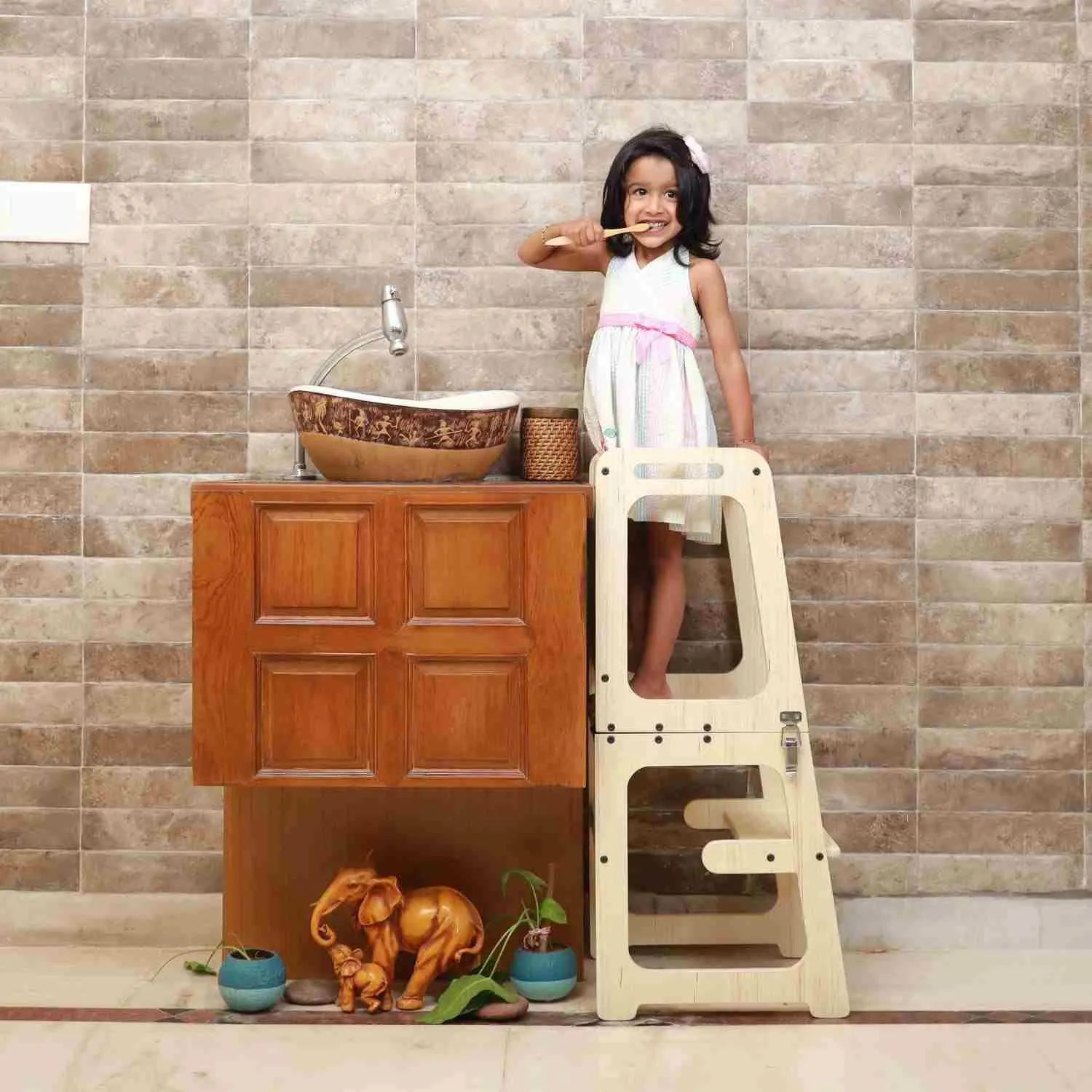
A learning tower is a raised, partially enclosed platform that brings a standing toddler closer to counter height. Unlike an ordinary stool, it typically has side panels or rails surrounding the child.
The format appeals to parents who want children to participate in washing vegetables, mixing batter, brushing their teeth or watching food preparation. For compact Indian homes, models that convert into a table or fold for storage may offer more value.
However, a tower is not automatically safe because it has rails. Multiple international recalls during 2025 and 2026 involved platforms collapsing, products tipping and openings presenting entrapment hazards. These recalls do not mean every learning tower is unsafe, but they show why construction should be examined carefully.
Prices below were observed on 2 September 2026 and may change.
Learning tower | Indicative price | Useful feature | Availability |
|---|---|---|---|
Ariro Natural | ₹9,944 | Adjustable and convertible | |
Shumee Montessori Tower | ₹9,799–₹11,999 | Converts into table and chair | |
Curious Cub Tower | Around ₹7,999 | Four-sided railing | |
WoodBee Tower | Check current price | Beech wood and birch plywood | |
SmartStep Tower | Around ₹9,680 | Foldable and height-adjustable | |
BabyLiv 3-in-1 | Around ₹4,990 | Lower-priced convertible format |
1. Ariro Natural: For Long-Term Everyday Use
Ariro recommends its learning tower for approximately 18 months to five years. It converts into a table, has an adjustable platform and supports up to 40kg according to the brand. View specifications
Suitable for: Families expecting regular kitchen and activity-table use.
Trade-off: It represents a considerable investment and still requires supervision every time.
2. Shumee Montessori Tower: For Multipurpose Furniture
Shumee’s bear-shaped tower converts into a table and chair. It was listed between ₹9,799 and ₹11,999 across Indian retailers during research. Shumee product information

Suitable for: Apartments where the product must provide both standing access and seated activity space.
Trade-off: Conversion hinges and locking points should be checked regularly for movement or wear.
3. Curious Cub: A More Accessible Indian Option
Curious Cub’s birch-plywood tower uses four-sided railing and was listed at approximately ₹7,999, although its direct website showed it as sold out during research. Marketplace availability remained visible. Current listing

Suitable for: Parents seeking a simpler locally available tower.
Trade-off: Confirm the current age guidance, warranty, platform adjustment and return conditions before ordering.
4. WoodBee: For Higher Stated Load Capacity
WoodBee states that its tower uses beech wood, birch plywood and water-based paint, with an age recommendation of 18 months and above and a stated capacity of 60kg. WoodBee specifications

Suitable for: Parents prioritising disclosed materials and a substantial wooden build.
Trade-off: A high weight limit does not independently prove resistance to tipping or entrapment.
5. SmartStep: For Space-Conscious Homes
SmartStep is foldable and height-adjustable. Its Indian seller lists a 48.25cm-square footprint, 84cm height, six-month warranty and damp-cloth maintenance. Seller information
Suitable for: Kitchens where permanent floor space is limited.
Trade-off: Folding mechanisms introduce additional locks and joints. Confirm that a child cannot release them while standing inside.
6. BabyLiv 3-in-1: Budget-Friendly but Verify Carefully
BabyLiv’s marketplace listing converts between a tower, dining chair and activity table and was priced around ₹4,990.
Suitable for: Families exploring the category at a lower price.
Trade-off: Request complete dimensions, recommended age, locking instructions, warranty and stability documentation. Price alone should not drive this purchase.
Safety and Buyer Checklist
Before buying or using a learning tower:
Choose a wide, stable base with no noticeable wobble.
Confirm that the standing platform locks securely.
Examine openings where a child’s head or torso could become trapped.
Prefer enclosed sides, rounded edges and non-slip steps.
Check bolts, hinges, rails and platform supports every week.
Place it on a level, dry, non-slip floor.
Keep it away from hot pans, flames, knives and accessible appliances.
Never allow climbing from the outside or unsupervised use.
Check international recall databases when buying an imported model.
A learning tower may encourage participation, but it does not create independence without supervision. For most Indian families, a locally supported adjustable or convertible model offers better practical value than an unidentified imported tower. Select the product whose stability and documentation you can verify—not the one promising the greatest number of functions.
FAQs
Is a learning tower suitable for a one-year-old?
Many reputable models begin at approximately 18 months. Readiness depends on stable independent standing, climbing ability and the manufacturer’s minimum age.
Is a learning tower safer than a chair?
Its rails and standing platform may offer more containment than an ordinary chair, but it can still tip, collapse or be climbed incorrectly.
Can children use a learning tower without supervision?
No. An adult should remain close enough to intervene throughout use.
Is a foldable or fixed tower preferable?
A fixed tower has fewer moving joints. A foldable model saves space but requires dependable locks and more frequent hardware checks.
Can it replace a high chair?
No. A learning tower is designed for supervised standing activities, not restrained feeding or infant seating.